I remember spending almost a decade listening to the same gaslighting techniques by specialists and doctors over and over again as a young adult. You’re a “healthy, young woman,” and nothing is coming up on any of these lab tests to suggest you have some underlying condition. Every time I had a flare-up that brought me to the ER or left me unable to go to work or have a regular routine, my blood work and lab results would return as normal.
As a young woman, I faced the added burden of what is called the ‘gender pain gap,’ where women’s pain is statistically more likely to be attributed to either stress or anxiety. My story isn’t unique; it’s a systemic pattern where functional pain in women is too often minimized while men’s functional pain is frequently overlooked or attributed to different causes.
My gastroenterology appointments would always be the same, handing me a pamphlet on irritable bowel syndrome (IBS), and then a diet sheet suggesting I try the FODMap route, and then sending me on my way. Yet, I seemed to suffer from stomach pain and issues daily, and in my 30s, they only became worse, where I’d have to cancel plans with friends because my stomach hurt too much to go out for dinner. I’d have to call in sick to work because I felt dizzy and like I was going to vomit if I stood up.
The Health Solution Comes Unexpectedly
And then just a few months after my 30th birthday, I had a really terrible flare-up that made me schedule an appointment with a new gastroenterologist. It turned out he would be sick that day, and I’d end up seeing his Physician’s Assistant instead. She was one of the first people to take my symptoms seriously and to listen to every detail as I explained them. At this point, I had become great at logging the symptoms, when they started, and what the pain felt like.
Then she mentioned that she had just learned about a diagnosis quite similar to what I was describing related to enzyme deficiency, which was really rare, but the test was simple and could be done at home.
I took the test home, and around a week later, I had results that I had Congenital Sucrase-Isomaltase Deficiency (CSID). I went further and also performed the Disaccharidase Assay, which measures tissue levels and biochemically tests the levels of digestive enzymes: lactase, sucrase, maltase, and palatinase.
And it came back with the same result: I was severely lacking in digestive enzymes.

My personal story about how I got a diagnosis isn’t some anomaly. I’ve spoken with dozens of people in the community who have had a similar experience to mine. I’ve also written about how hard it has been to navigate a healthcare system that typically focuses on the structural and not functional problems of patients.
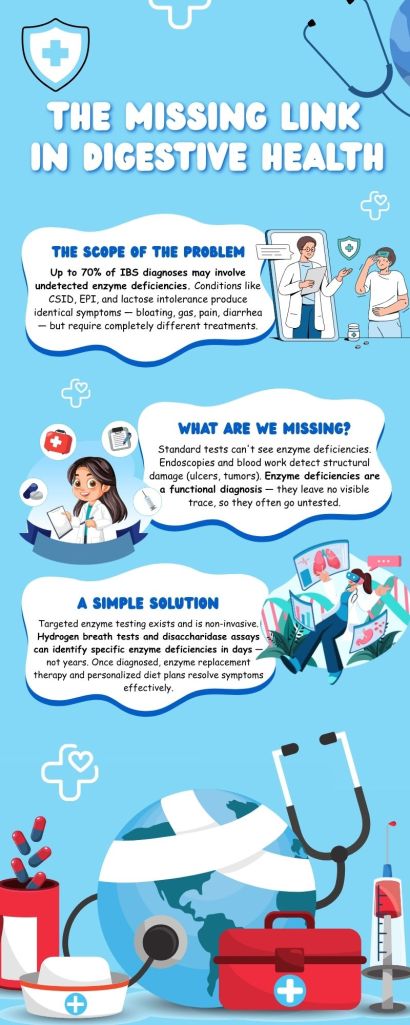
Digestive enzyme deficiencies like CSID, lactose intolerance, fructose intolerance, and Exocrine Pancreatic Insufficiency (EPI) are being underdiagnosed in the medical community.
These, of course, are functional disorders, and often leave no trace on standard structural tests like an endoscopy. Specialists are rigorously trained to rule out structural emergencies like tumors or ulcers. However, this training creates a blind spot for functional disorders like CSID and EPI, where the anatomy looks normal, but it is the chemistry that is broken. When doctors rely solely on structural tests, they aren’t necessarily ignoring patients—they are simply looking for the wrong clues.
This is a systemic issue because the thing that brings in profit to hospitals are surgeries and prescription medication, and not functional disorders that can be solved through correcting and personalizing a diet plan.
What’s the Cost of Delaying Diagnosis?
It means patients are now spending years trying to navigate through unnecessary medications, false diet plans, misdiagnosis, and, not to mention, the mental health toll patients experience when they’re told over and over again that their symptoms are “all in their heads.”

It instills a distrust in our healthcare system and our medical specialists that becomes difficult to ignore.
Enzyme deficiencies going untreated also means the body can’t properly absorb nutrients, and it leads to vitamin deficiencies, malnutrition, and a diminished quality of life and ability to perform everyday tasks.
In 2021, a double-blind, placebo-controlled trial (NCT04917913; I’ve linked it for reference) demonstrated that multi-enzyme blends reduced both bloating and pain in patients with mild gluten sensitivity and lactose malabsorption. Studies on EPI show that pancreatic enzyme replacement therapy is the gold standard for restoring nutrient absorption, yet many patients remain undiagnosed, even with research published just five years ago highlighting its success in patient outcomes.
A Path to Personalized Care
I’ve been lucky enough to switch to a Direct Primary Care alternative doctor who can help me set up a personalized nutrition plan and find the right vitamin and supplement regimen, and we do proactive testing to discuss enzyme deficiencies. She never makes me feel like I’m making up a symptom and always takes time to discuss healthy habits and preventive care measures instead of trying to push pharmaceutical or surgical solutions to solve issues.
I know firsthand how exhausting it is to be told your pain is ‘all in your head’ when you are suffering daily. I felt dismissed, invalidated, and unheard. But I also learned that many doctors are simply working with an incomplete map of the patient as a “whole.” They are trained to find structural damage and inadequacies, not enzyme deficiencies and functional problems, and the tests are also made for this training.
This doesn’t mean you should stop fighting for a better healthcare solution.
It means you need to fight smarter. When your labs come back normal, but your pain persists, push for functional testing. Ask specifically about CSID, EPI, or disaccharidase assays. You are the expert on your own body; the doctor is the expert on the tools you can use. Together, you need to bridge the gap and not rely solely on what they’ve been trained on.
We need a healthcare system that listens to the whole patient, not just the scan results. Until the training catches up, patients must be their own advocates. Your symptoms are real. The solution exists. Don’t let a ‘normal’ test result silence you.


Leave a Reply